
We’ve got our EYES on FUNCTION 👀
Let’s talk about our VISION! As occupational therapists we screen for acuity (how clearly your eyes see), we assess ocular motor skills (how your eyes move) and we assess how your brain processes what you see (visual fusion, visual perceptual skills), and how your eyes impact your function.
According to the American Optometric Association (AOA), a child should have their first comprehensive vision exam between 6-12 months to check for proper eye development. Optometrists look at the health of the eye, the acuity of the eye and prescribe glasses if required.
Optometrists should be seen for further check ups starting around age 3 and continuing annually before each school year. At this age, an optometrist can test for eye teaming issues like amblyopia (“lazy eye”).
Occupational therapists are experts in task analysis. This means we look at the whole picture, break a task down into its component parts, and work from the bottom up to help children succeed in desired or required tasks. For example, handwriting requires the EYES and the HANDS, among other skills. If we expect a child to improve their writing, but we only work on their hand strength we are likely missing an important piece of the puzzle.
Developmental milestones play a critical role in supporting visual development. For example, the asymmetrical tonic neck reflex (ATNR), is present at birth and activates arm extension in response to a change in head position. This facilitates visual attention to their extended hand and thus supports hand eye coordination development!
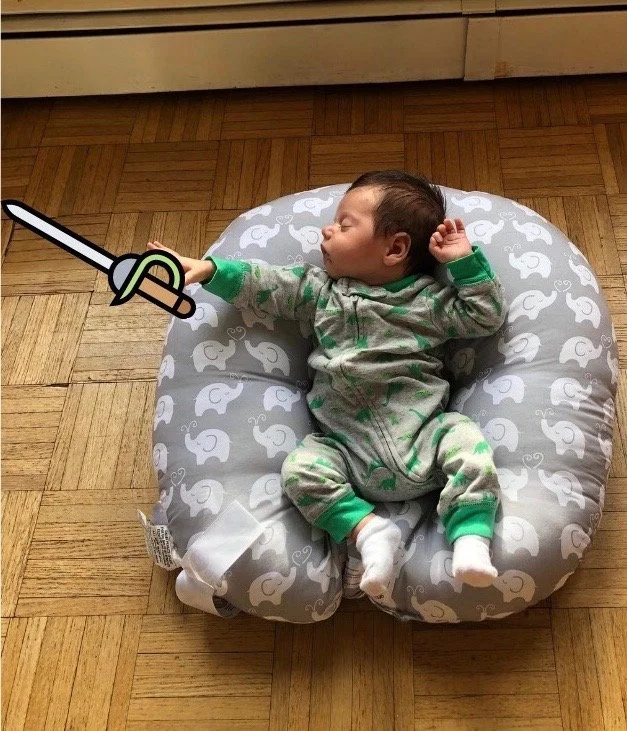
The ATNR is nicknamed “the fencers reflex.” Notice the eyes are turned toward the extended side.
Another reflex, the symmetrical tonic neck reflex (STNR) allows the arms and legs to move in response to a change in head position. When the head looks up, the arms straighten and legs bend. This facilitates a quadruped position to help with crawling. It also activates a visual response: when the head moves down the eyes converge (focusing at near) and when the head moves up the eyes diverge (focusing at far).
Occupational therapists should always screen for functional visual skills. Because we take in the whole picture we know that if a child is referred for difficulties with movement or motor planning, we need to assess reflex integration and functional visual skills in order to progress our kiddos to the higher level tasks they need to do.
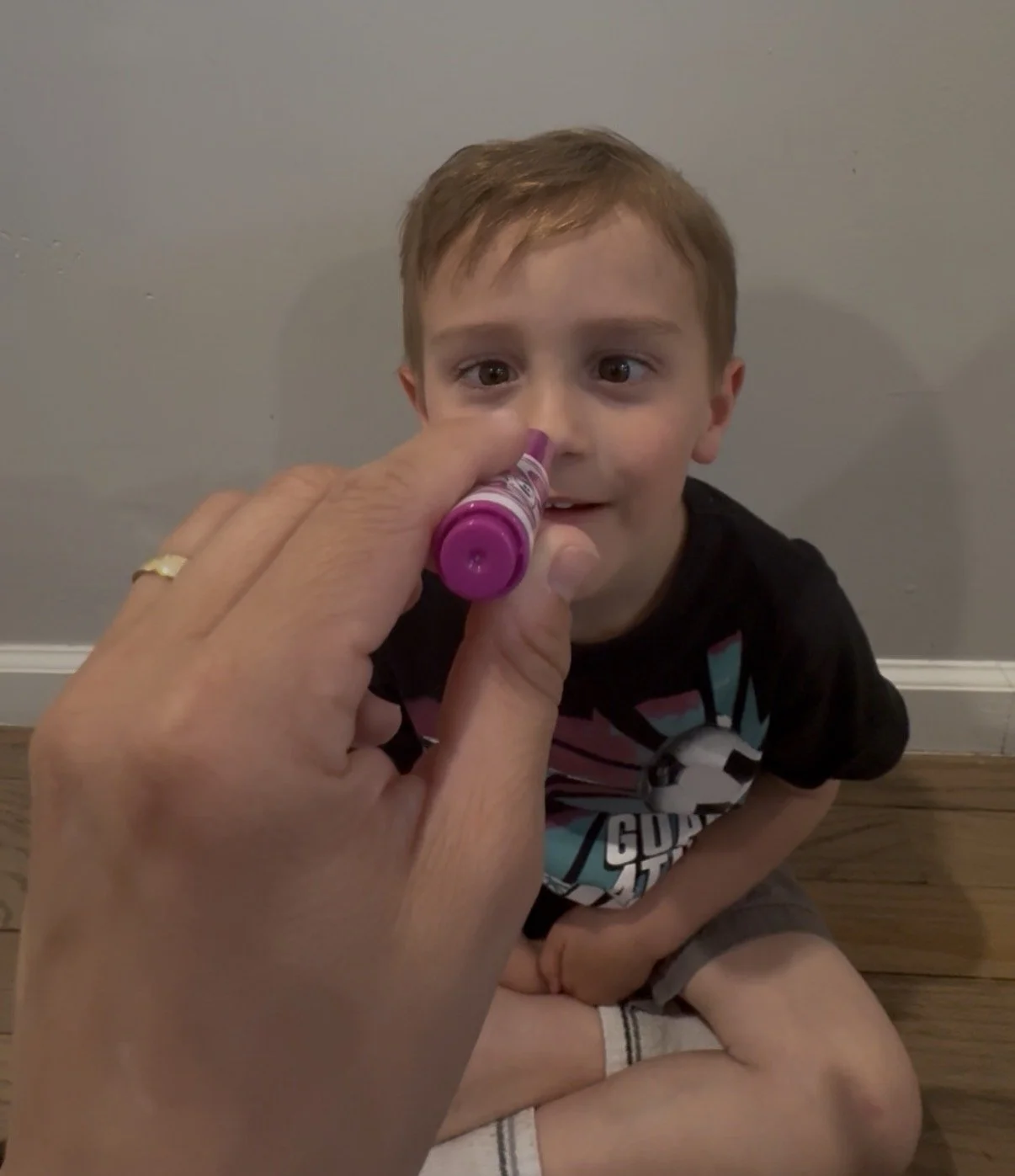
Our therapist assessing convergence (the ability to team the eyes together on a target at near).
Functional visual skills refer to your entire visual system- the eyes, the muscles around the eyes, how your eyes send signals to your brain, and how your brain interprets and responds to the information to interact with your environment. We need to have our best correction, but we also need our eyes to stabilize to focus on things in our environment, to track moving objects (pursuits) to catch a tossed ball, to efficiently jump between targets (saccades) for reading, to focus on things at near (convergence & depth perception) to be able to write on a line, and to shift gaze from near to far (accommodation) to copy from the board.

saccadic eye movements (source: https://www.braintoolkit.ca/all-exercises)

smooth pursuit eye movement (source: https://www.braintoolkit.ca/all-exercises)
Our occupational therapists are passionate about identifying and treating ocular motor and functional visual deficits as part of the whole picture to progress our children toward their goals.
One of our therapists assessing smooth pursuits. This child is having a difficult time dissociating his eye and his head movements (tracking object with his whole body). This is a common compensation for difficulties with smooth pursuit eye movements.
If you think your child may have visual dysfunction- we are happy to evaluate and discuss.
Elizabeth Binckes, MS, OTR/L, CNS